

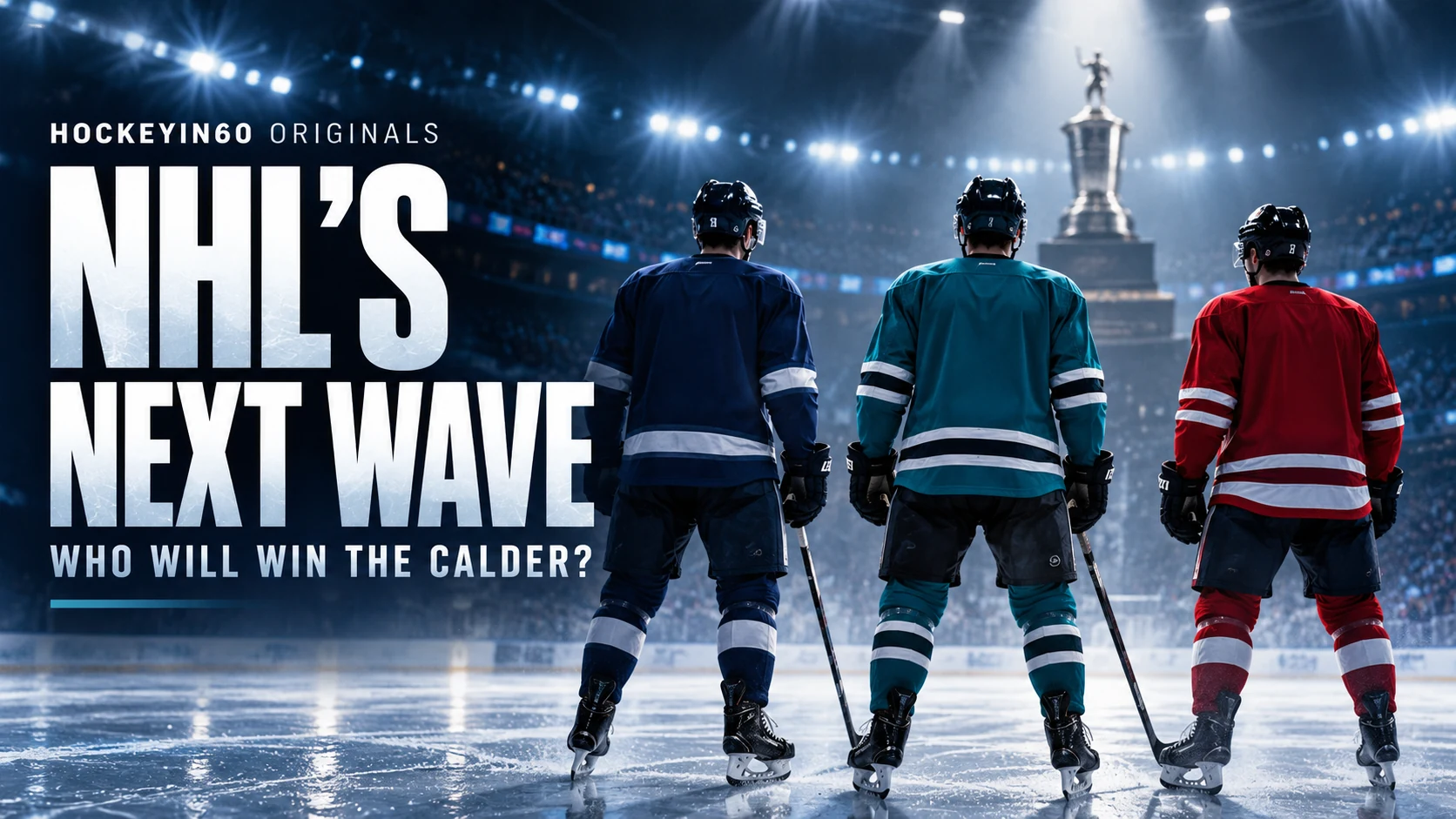
NHL’s Next Wave: The Best Rookies So Far—and Our Early Calder Trophy Pick
Sportsin60 Originals ·
A look at the NHL’s leading 2026–27 rookies, their early production and why Ivar Stenberg is our early Calder Trophy pick.
Hockeyin60 Originals | October 27, 2026. Statistical snapshot: games through October 26 unless otherwise noted. Award rankings below are our editorial assessment.
The NHL’s newest players are already making the rookie-of-the-year race interesting. There is no runaway candidate, and the player with the biggest reputation does not automatically have the strongest early case.
James Hagens and Ivar Stenberg are setting the scoring pace. Michael Brandsegg-Nygård and Trevor Connelly are close behind, while Gavin McKenna remains firmly in the conversation. At other positions, Cole Hutson and a pair of young goaltenders offer a reminder that this award should measure more than goals and assists. [1][2]
Our early pick is Stenberg. That is a prediction about where the season could go, rather than a declaration that the race is settled. Hagens has a persuasive case already, and a few changes in playing time could rearrange this field quickly.
Who is leading the rookie race?
Here is a snapshot of the leading rookie skaters. This is a scoring comparison, not our predicted order of finish. [1]
| Player | Team | Goals | Assists | Points |
|---|---|---|---|---|
| James Hagens | Boston Bruins | 4 | 5 | 9 |
| Ivar Stenberg | San Jose Sharks | 3 | 6 | 9 |
| Michael Brandsegg-Nygård | Detroit Red Wings | 2 | 6 | 8 |
| Trevor Connelly | Vegas Golden Knights | 4 | 4 | 8 |
| Gavin McKenna | Toronto Maple Leafs | 3 | 5 | 8 |
| Anton Frondell | Chicago Blackhawks | 1 | 5 | 6 |
| Cole Hutson | Washington Capitals | 2 | 3 | 5 |
| Porter Martone | Philadelphia Flyers | 3 | 2 | 5 |
The gaps are tiny. One productive evening can change the order, which makes the context behind those totals particularly important.
Ivar Stenberg: Our early favourite
Stenberg has nine points in 12 games. Seven have come on the power play, and San Jose tried him alongside Macklin Celebrini and Will Smith on its top line at practice on October 26. [3]
That combination of production and opportunity is the foundation of our pick.
Power-play access gives a rookie repeated chances to handle the puck in dangerous areas. A promising top-line opportunity could add another route to points. If Stenberg holds both roles, he has a plausible path to staying near the front of the scoring race.
The important word is “if.” A practice combination is not a season-long guarantee. He still needs to make that opportunity last.
There is also an obvious question in his scoring profile: can he produce more regularly outside the power play? Special-teams points count fully, but an award case becomes more convincing when a player can influence games in several situations.
Our view: Stenberg has the most appealing combination of an established early return and a potential increase in opportunity. We would watch his next stretch of even-strength play closely before making the prediction more confidently.
James Hagens: The strongest challenge
Hagens has nine points in 12 games while averaging 12:56 of ice time. [4]
That makes him particularly interesting.
The case for Hagens is about what he is already accomplishing with the minutes available. If his responsibility expands and the production follows, he could move from a co-leader in October to the player everyone else is chasing.
There are two ways to read an efficient early start. One is that a talented player is ready for more. The other is that a small sample is flattering his results. The next stage is finding out which explanation holds up when opponents have more information about him.
For Boston, the ideal development would be steady growth in responsibility without sacrificing the parts of his game that keep him in the lineup. For award voters, that would create a persuasive story: a rookie who earned a larger job and continued to produce.
If we were choosing the most compelling challenger to our Stenberg prediction, Hagens would be first.
Michael Brandsegg-Nygård: Look beyond the headlines
Detroit’s rookie has eight points, and the through-October-26 tracker credits him with 28 shots and no power-play points. [5]
That is a useful contrast within this group. His production has not depended on a stream of power-play scoring.
For a rookie, generating chances outside premium special-teams minutes can be valuable evidence. It suggests a route to contributing even when the team is not drawing penalties or a coach changes the power-play units.
The question now is whether he can keep creating those opportunities as the season gets harder. Opponents adjust. Travel accumulates. A young player who looks comfortable in October still has to show he can maintain his effectiveness in January.
He belongs in the serious conversation, particularly for readers looking beyond the most prominent names.
Trevor Connelly: Already in the scoring mix
Connelly’s eight points include four goals, keeping him close to the early leaders. [1]
His challenge is to turn a strong opening into a durable role.
For an attacking rookie, highlight plays can attract attention quickly. The harder part is becoming dependable enough that a coach keeps sending him out when the game is tight and one mistake could decide the result.
That is the development to watch here. Does the scoring remain consistent? Does his responsibility grow? Can he contribute through a quiet offensive stretch?
If those answers are positive, he can remain a contender without needing to dominate the conversation every week.
Gavin McKenna: Still very much in it
McKenna has eight points, only one behind the scoring leaders in this snapshot. [1]
That is hardly a reason to panic about his place in the race. It is also not a reason to hand him the award on reputation.
Our approach is to judge what a player is doing, then ask what might change. A highly regarded rookie can improve substantially as he becomes more comfortable with NHL timing, positioning and the demands of a full schedule.
The important indicators are repeatable chances, a stable role and increasing involvement. A short scoring streak can move anyone up the table. Sustained progress is what would make McKenna our preferred pick later in the season.
He remains a major threat to the prediction.
Do not overlook the defenceman—or the goalies
Hutson’s early return is five points in 10 games while averaging 19:12 of ice time. [2]
A defenceman should not have to match the leading forwards point for point to deserve consideration. Moving the puck efficiently, defending space and handling meaningful minutes can provide value that the scoring table misses.
The goalies deserve a separate look, too. The available snapshot lists Montreal’s Jacob Fowler at 4–1 with a 1.94 goals-against average and .910 save percentage in five appearances. The Rangers’ Dylan Garand has four wins, a 2.65 goals-against average and .900 save percentage in nine appearances. [2]
Those samples are still small. For either to become our preferred Calder candidate, we would want to see strong results over a substantial workload. Wins help tell the story, but save percentage, shot quality faced and consistency matter when separating the goalie’s contribution from the team around him.
What about Frondell and Martone?
Frondell and Martone remain worth watching, but the current scoring snapshot puts them behind the leaders. [1]
Neither should be dismissed because of a modest October gap. A rookie’s role can change dramatically over a season. A promotion, an injury elsewhere in the lineup or an improved understanding with linemates can create a very different second month.
The reverse is also true: an impressive prospect résumé cannot substitute for NHL performance.
The fairest approach is to keep both in the discussion and look for evidence that their opportunities and impact are growing.
Who can actually win the Calder?
“New player” and “eligible rookie” are not always the same thing.
Under the NHL’s published rules, a player must be under 26 on September 15, must not have exceeded 25 NHL games in a previous season, and must not have played six or more NHL games in each of two previous seasons. [6]
That allows some players with a brief earlier NHL appearance to remain rookies. It also means a young established player is not automatically eligible just because fans still think of him as part of the next generation.
Our prediction: Stenberg, with Hagens close behind
Our early editorial top three are Stenberg, Hagens and McKenna, with Brandsegg-Nygård close enough to force his way into that group.
Stenberg gets our vote because the scoring is already there and the potential opportunity is attractive. Hagens is the challenger whose current production makes it hardest to feel comfortable with that choice. McKenna remains close enough that a strong month could change the entire argument.
The test from here is straightforward: keep producing, earn more trust and remain effective when the easy points disappear.
October has given us a competitive race. Stenberg is our pick today—but the best rookie will be the player who can turn this promising start into a full season.
Sources and further reading
- [1] StatMuse — 2026–27 rookie scoring snapshot
- [2] PickALeague — rookie skater and goaltender statistics
- [3] NHL.com — October 27 fantasy preview: Stenberg’s production and role
- [4] NHL.com — Rookie Watch, October 26
- [5] Bobby’s Sports Analytics — rookie tracker, games through October 26
- [6] NHL — Hockey Operations Guidelines: rookie qualifications